ReDesign
Recovering Editable Design Structures from Images via Agentic Decomposition




 Paper
Paper Code
Code Dataset
A flat image is a dead end.
When the design file is lost, only pixels remain.
You can't move an element, recolor a shape, fix a typo, or reflow the layout.
ReDesign grows the design back.
A vision-language controller rebuilds the layer hierarchy as a tree, coarse to fine,
verifying every step until each element is atomic.
Every element, editable again.
Text layers, vector shapes, grouped elements with z-order
recovered from a single image, ready to re-edit.
ReDesign Recovery: Edit Playground
1Pick a design to see how the ReDesign agent recovered editable design structures.
What ReDesign Does
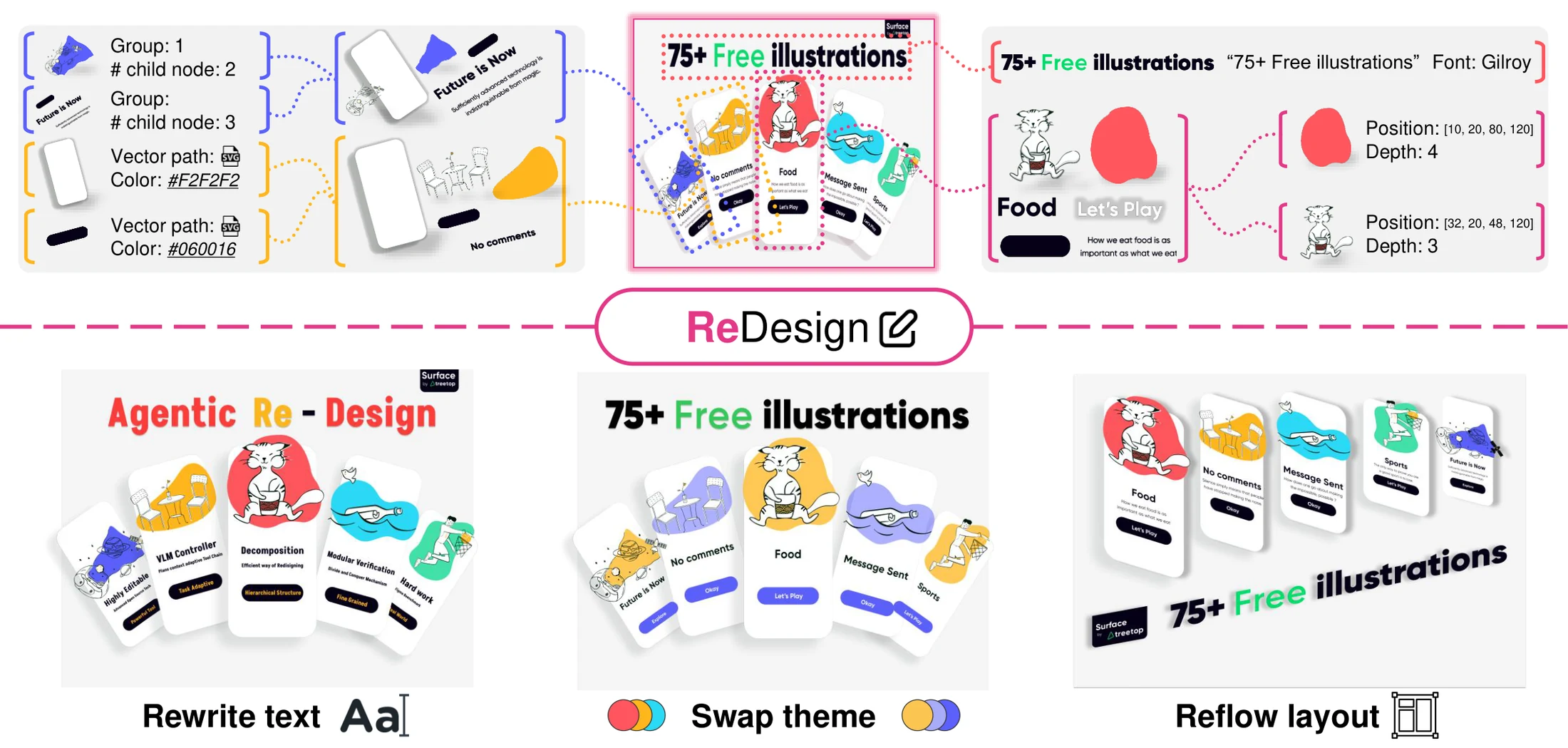
ReDesign recovers a fully editable design hierarchy from a single image.
A vision-language agent extracts semantic text layers, vector shapes, and grouped elements, making every element editable.
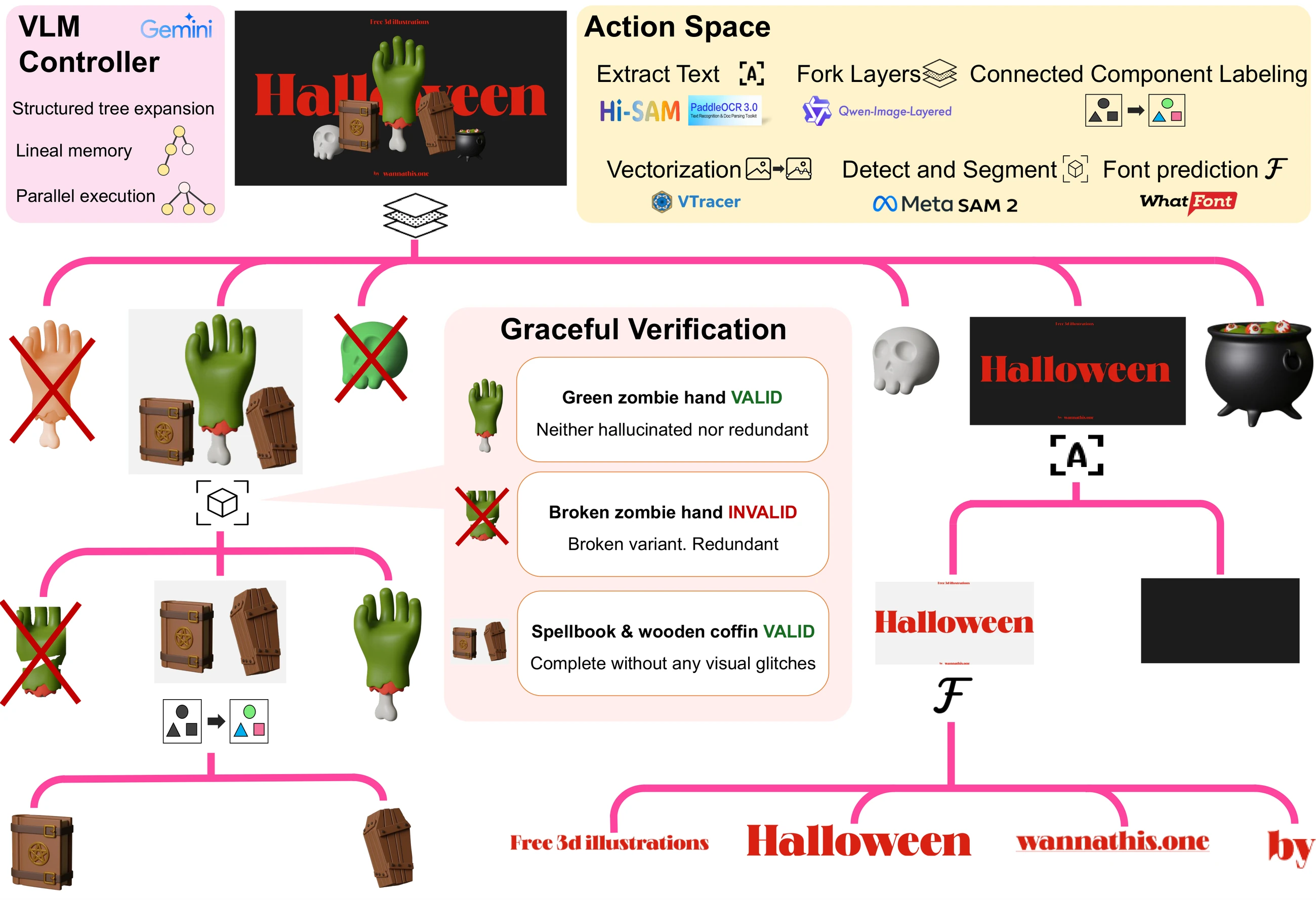
The Agentic Approach: Grow the Tree
Starting from the whole image as the root, a VLM controller expands an editable layer hierarchy
by selecting and composing specialized tool actions across modalities,
checking the validity of each editable element, and repeating until every element is atomic and editable.
Five Tool-Backed Actions
Reconstruction Accuracy
On the Figma-909 benchmark of 909 real-world designs, ReDesign wins on every metric.
| Method | L1 ↓ | PSNR ↑ | LPIPS ↓ | PQ ↑ | F1 ↑ |
|---|---|---|---|---|---|
| VTracer | 0.0977 | 20.487 | 0.1917 | 24.64 | 0.309 |
| LayerD | 0.0704 | 16.141 | 0.3381 | 30.09 | 0.350 |
| Qwen-Image-Layered | 0.0493 | 26.192 | 0.1073 | 35.37 | 0.429 |
| Tool Agent | 0.0493 | 13.923 | 0.3869 | 45.33 | 0.527 |
| Ours | 0.0431 | 26.286 | 0.0883 | 45.37 | 0.535 |
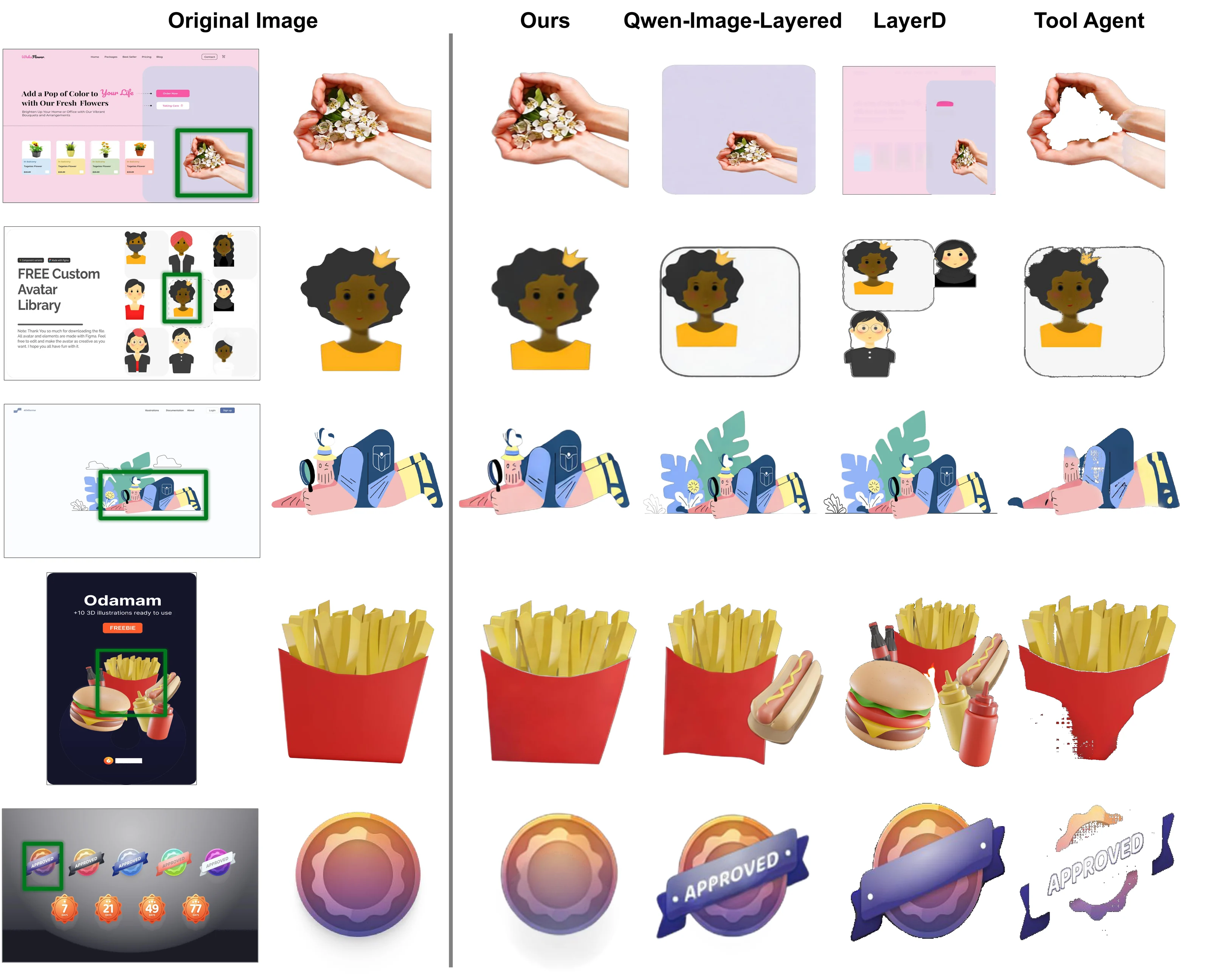
Per-Element Reconstruction
Editability: Structure That Survives Edits
Six atomic edits on reconstructed designs, measured against ground truth. ReDesign dominates on all axes.
Edit Types Tested
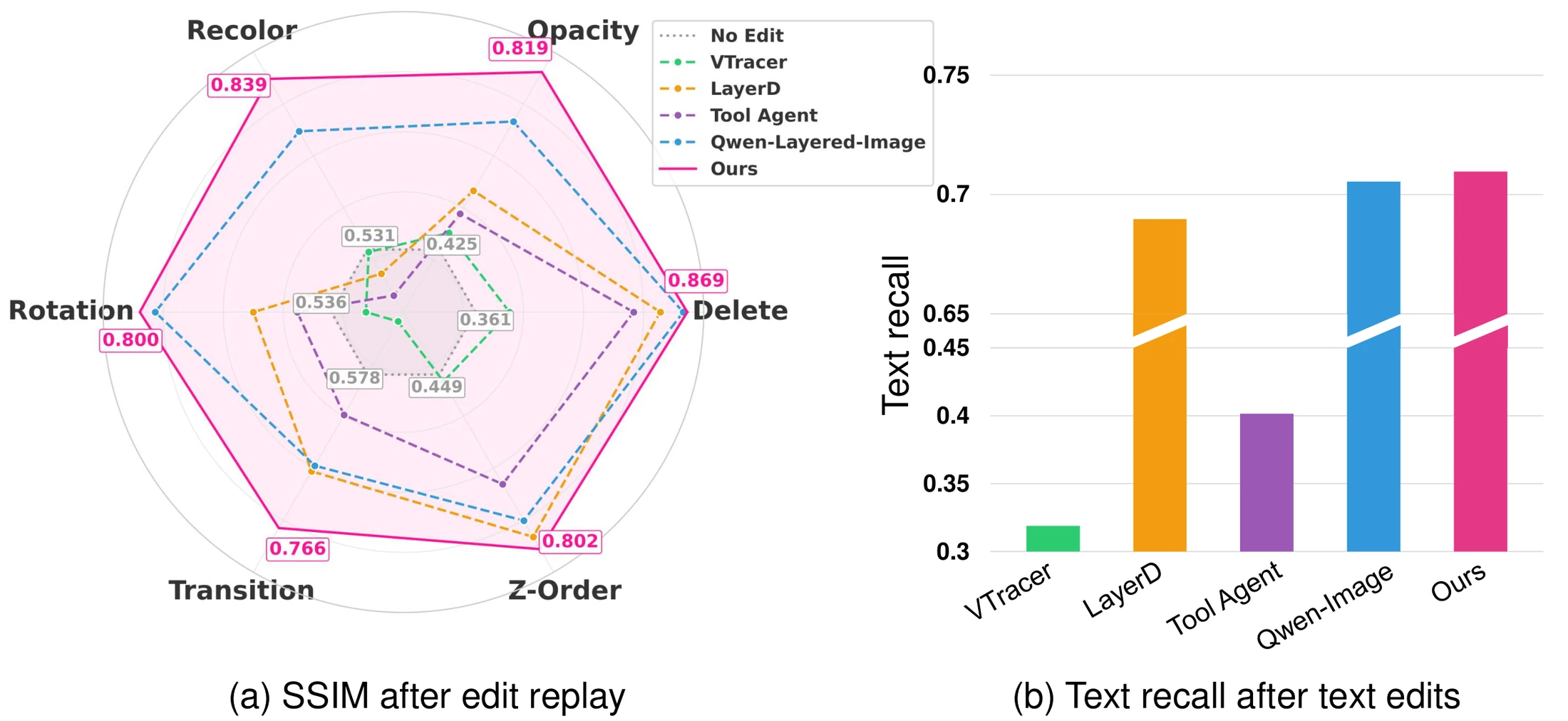
ReDesign dominates. Results show structure survives diverse real edits.
Edit Examples: Before & After
ReDesign applies each edit cleanly to the correct element. Baselines move wrong regions or corrupt the layout.
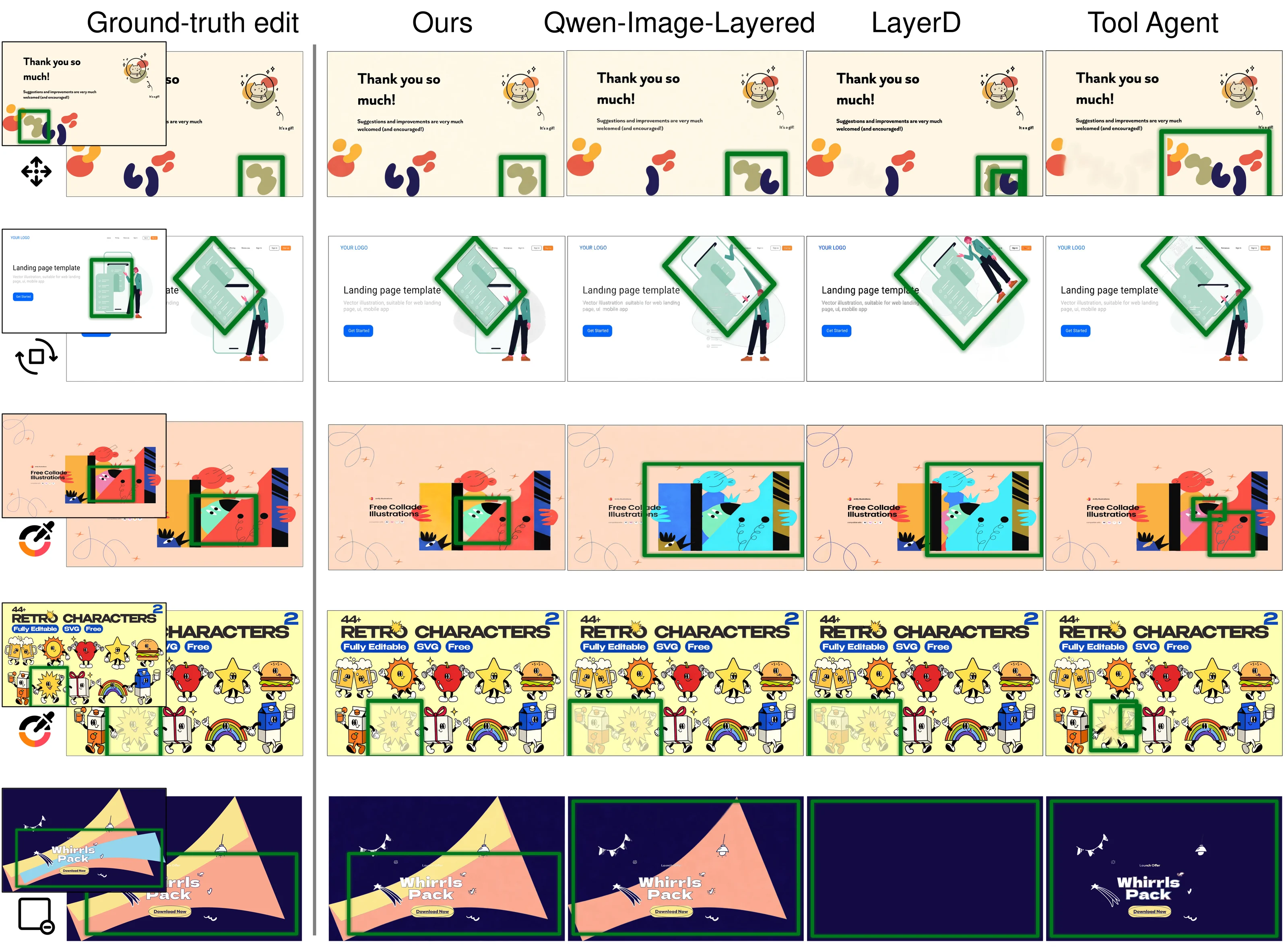
ReDesign's edits are precise and preserve layout integrity, while baselines fail or distort.
Why Structure Beats Pixel Regeneration
Generative editors (Nano Banana 2) edit pixel-space: instructions leak, layouts blur, precision fails.
ReDesign exposes discrete layers with explicit position and rotation, so edits execute exactly.
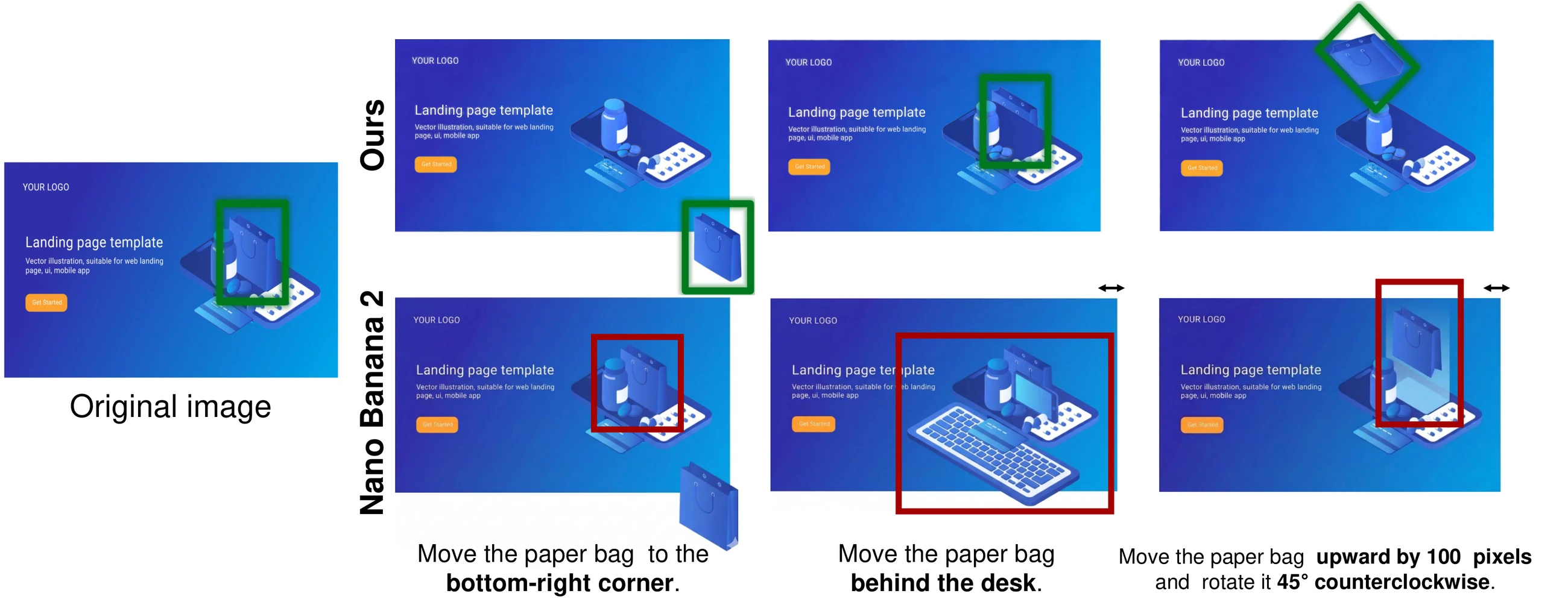
Nano Banana 2 (red, bottom) misplaces and corrupts surrounding design.
Figma-909: The Benchmark
To evaluate editability at scale, we introduce the Figma Edit Replay Benchmark.
All 909 frames redistributed under CC BY 4.0 with full attribution. Download on HuggingFace.